

When an executive coaching client of mine asked: “How can I be more mindful and proactive with my team, rather than reactive?” I could empathize with him.
We all feel a range of emotions every day, especially on particularly stressful days, and yet Susan David reminds us: emotions are data, not directions. In other words, while all emotions are OK to experience, we don’t have to act on all of them – we can be intentional about how we act on our emotions, guided by our values and purpose.
“Emotions are data, not directions”
-Susan David, author of Emotional Agility
Over the years, I’ve learned about myself that timing matters. When it comes to creating new content or strategic thinking, I need to be in a certain mindset – more open and generative. So, if I’m feeling more stressed and closed, I will choose not to do those tasks – or, I can try to activate a more open and generative mindset by carving out some unstructured time to restore myself. I call this intentional (rather than reactive or autopilot) leadership.
Defining and Practicing Intentional Leadership
I define intentional leadership as is the practice of building awareness → thinking forward → and then choosing actions (…that positively impact the energy, performance, and growth of ourselves, our teams, and our organizations).
The word “intentional” comes from the Latin root word intentio, which means a “stretching out of the mind toward an object or goal.” Intentional Leadership is about thinking and visioning forward – a desired future – and then stretching one’s actions and behaviors toward it.
In order to do this, we have to spend time envisioning who we envision ourselves to be, at our best, when we use our strengths, are guided by our values, and have the kind of impact we want on a day-to-day and more global basis.
Creating Your Leadership Philosophy
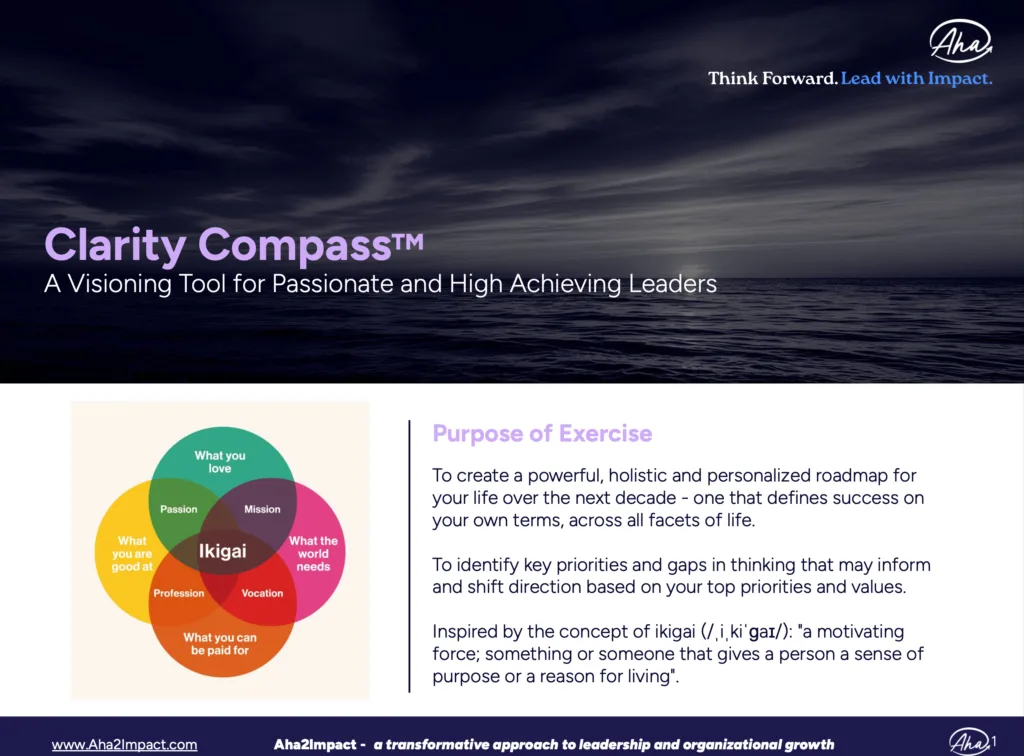
In working with executives and leaders for over 25 years, one of the first things we focus on is creating an empowering leadership philosophy. A leadership philosophy can be informed by a personal purpose (your “why”), a personal vision (your ideal future impact), and/or a personal mission (how you achieve your ideal future impact). The philosophy is informed by your strengths, your values that guide you, and how you envision your ideal impact.
There is no “right” or “wrong” way to create one because each is unique and personal to the leader. Years, ago, I wrote an original LinkedIn post where I shared a specific methodology for creating a ‘leader impact statement’ that included a worksheet. Today, I encourage leaders to create their own process without attachment to a “right” way – remember that while you may eventually share your leadership philosophy with others, it is meant for your eyes and use.
What is most important is that your leadership philosophy resonates deeply with YOU.
Carve out some time and a quiet space to reflect on and consider your “why.” Perhaps pour a cup of tea or coffee, take a few deep breaths to ground yourself, and allow yourself to feel any emotions that come up. Give yourself some space to reflect and vision. Then, write down what matters most to you about your work, your presence, and your impact in the world.
Some people ask me if their philosophy should be only work focused or all encompassing. Again, there is no “right” or “wrong” – but I encourage you to consider writing something that isn’t tied closely to a particular role, job or organization. Make it about you – your identity and what you care most about.
Bringing Your Leadership Philosophy to Life
Once you have your philosophy written, put it somewhere you can see it regularly: maybe a sticky note on your laptop or print and post to the wall. During tough days or when faced with difficult decisions, read it and then ask yourself how you would proceed with your philosophy guiding you. Your leadership philosophy can also help guide the creation of your organizational, professional and leadership goals.
I encourage leaders to revisit and even rewrite their leadership philosophy each year. I do this process myself and my current version of my personal purpose and leadership philosophy is: (Using my strengths of ______ and guided by my values of ___________) to create space for new thinking that inspires growth and positive impact individually and collectively. I also include with mine one of my favorite quotes:
“When the best leader’s work is done the people say, ‘we did it ourselves.'”
– Lao Tzu