

In leadership, one of the most persistent challenges is discerning what deserves our time, attention, and commitment in the midst of competing priorities that are often all worthy in their own right. Many of the leaders I work with are navigating an abundance of meaningful options, each carrying its own demands, trade-offs, and potential impact. Traditional decision-making frameworks, like the Eisenhower Matrix, tend to prioritize things like urgency, outcomes, or strategic alignment, yet they often overlook a more fundamental dimension of sustainable leadership: energy.
Most leaders, managing complex demands and wearing many hats in their roles, experience varying levels of energy inputs and outputs throughout their days. Over the last several years, I started using – for myself personally and, then, with coaching clients – a simple framework to support more intentional decision-making. I call it the Energy Equation:
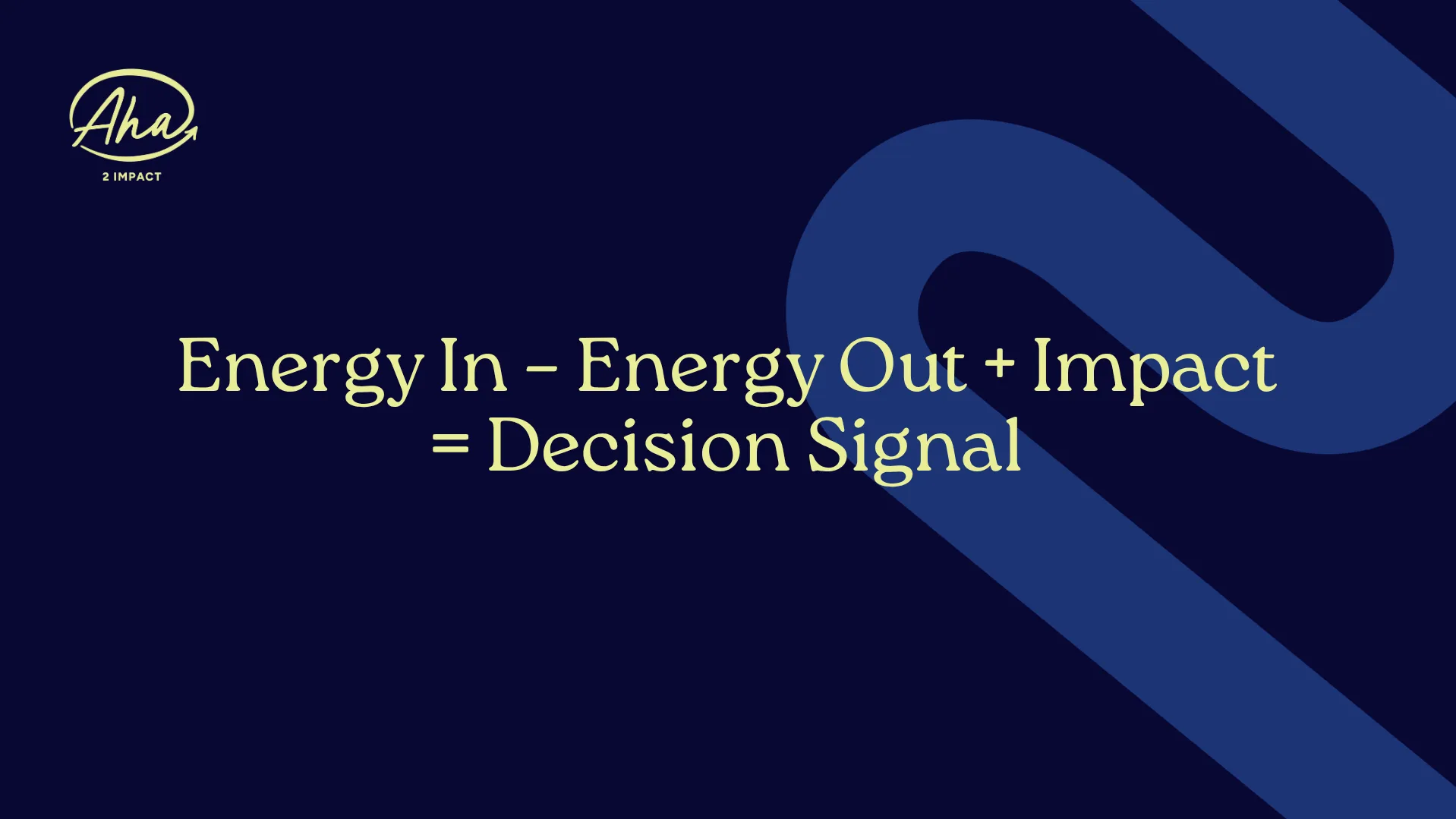
Each variable is rated on a scale of 1 to 10. While the maximum numerical outcome is 20, the true value of the equation lies not in the final score, but in the clarity it creates about the trade-offs embedded in any given choice.
This approach is grounded in a growing body of research suggesting that energy, rather than time, is the most critical resource leaders must manage. Scholars and practitioners such as Tony Schwartz and Jim Loehr have long argued that performance, resilience, and well-being are directly tied to how effectively individuals invest and renew their energy across physical, emotional, and cognitive domains (Loehr & Schwarts, Making of a Corporate Athelete, Harvard Business Review, 2001). Because energy comes in different forms, it’s possible to experience a surge of one kind of energy while also experiencing a depletion of another – for example, being mentally stimulated by something that is also physically exhausting. Leaders may have control over their calendars, but far less awareness of what sustains or depletes them as they move through those commitments.
Using the Energy Equation for Sustainable Leadership and Clear Decision-Making
The first component of the equation, Energy In, represents the degree to which an activity fuels you. This is not simply about enjoyment, but about a deeper sense of engagement and vitality. It is often reflected in moments where time seems to pass quickly, where focus sharpens, and where the work itself feels intrinsically rewarding. This concept aligns closely with the research of Mihaly Csikszentmihalyi, who described “flow” as the state in which individuals are fully immersed in meaningful challenge. For many leaders, Energy In might come from strategic thinking, solving complex problems, mentoring others, or creating something new.
In contrast, Energy Out captures the cost associated with an activity. Importantly, this is not inherently negative. All meaningful work requires effort, and often significant effort. Energy Out reflects the cognitive load, emotional labor, physical demand, and contextual switching required to engage in the work. What makes this dimension particularly important is that high Energy Out can coexist with high Energy In. For example, many leaders in healthcare or education describe days spent continuously interacting with others, making high-stakes decisions, and remaining fully present in dynamic environments. They often report that this work is deeply meaningful and energizing, rating it highly in Energy In, while simultaneously acknowledging the substantial physical and emotional depletion it creates, resulting in equally high Energy Out. The net effect is not purely positive or negative, but complex: they leave both fulfilled and exhausted.The third component, Impact, introduces a critical layer of meaning and alignment. Impact reflects the extent to which an activity contributes to the outcomes, values, and broader purpose that matter most to you. It asks whether the work moves you closer to the kind of leader you aspire to be and the difference you seek to make. Research from organizational psychologist Adam Grant highlights that when individuals perceive their work as meaningful and connected to others, they demonstrate greater persistence, engagement, and resilience, even in the face of challenge. In this way, Impact can justify, and even transform, how we experience both Energy In and Energy Out.
Prioritize High-Impact, High-Sustain Commitments
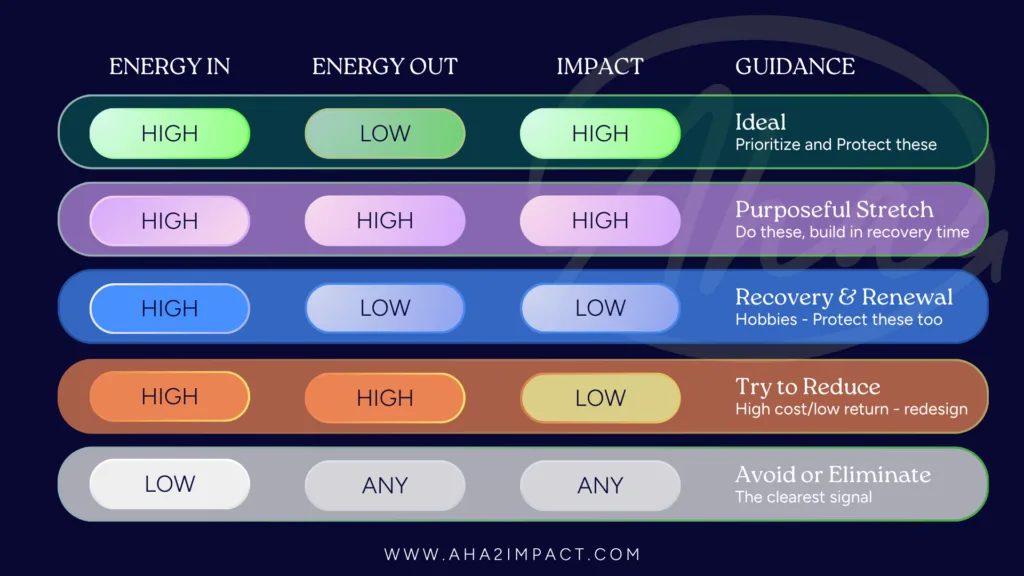
When considered together, these three variables reveal patterns that are often obscured in more traditional approaches to decision-making. Activities that are high in Energy In, low in Energy Out, and high in Impact represent a clear area of alignment and sustainability; these are the commitments that leaders would be wise to prioritize and protect. Equally important, however, are the activities that are high in both Energy In and Energy Out, and also high in Impact. These represent what might be called purposeful stretch zones or work that is deeply meaningful and engaging, yet inherently demanding. Rather than avoiding these commitments, the goal is to approach them with intentionality, ensuring they are balanced with recovery and not allowed to dominate one’s time indefinitely.
The framework also surfaces areas of misalignment that are easier to ignore without this level of reflection. Activities that are low in Energy In, high in Energy Out, and low in Impact are particularly costly, as they deplete resources without contributing meaningfully to desired outcomes. These are often candidates for delegation, redesign, or elimination. Meanwhile, there are also categories of work that may be energizing but low in impact, or impactful but not energizing. These are not inherently problematic, but they require conscious calibration to ensure they do not crowd out more aligned opportunities.
Beyond Burnout: 3 Questions to Define Your Energy Strategy
Perhaps the most important insight this equation offers is that the goal is not to eliminate all sources of effort or depletion. Leadership, by its nature, involves trade-offs, complexity, and moments of strain. Instead, the goal is to make those trade-offs consciously, choosing when and where to invest energy in ways that are aligned with both personal vitality and desired impact. When leaders begin to evaluate decisions through this lens, they often find that they already possess an intuitive understanding of what is sustainable and what is not; the equation simply provides a structured way to articulate and act on that awareness.
In practice, this can be as simple as pausing before committing to a new opportunity and asking three questions:
- How much will this fuel me?
- How much will this require from me?
- And how much does this matter in the context of the impact I want to have?
The answers rarely produce a perfect score, but they do illuminate the nature of the choice.
In a landscape that often rewards overextension and equates productivity with value, the Energy Equation offers an alternative: a way to make decisions that are not only strategic, but sustainable and aligned. Over time, these choices accumulate, shaping not just how leaders spend their time, but how they experience their work and the impact they ultimately create.